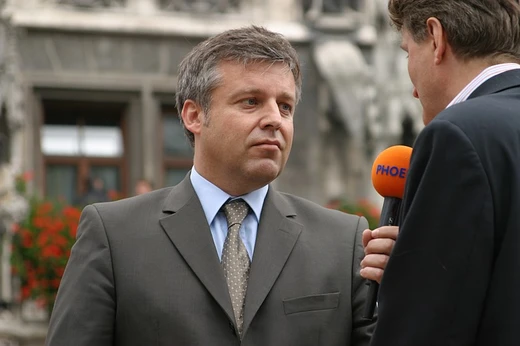
Jeremy Paxman
English broadcaster known for his forthright interviewing style.

Jeremy Dickson Paxman (born 11 May 1950) is an English former broadcaster, journalist and author, born in Yorkshire. He is best known for his long tenure as a presenter on the BBC Two programme Newsnight, where his forthright and often confrontational interviewing style became a hallmark of British political journalism. He also served as the quizmaster of University Challenge from its revival in 1994 until he stepped down in 2023.
- born
- 11 May 1950, Leeds, West Riding of Yorkshire, England
- field
- Broadcasting, journalism, authorship
- nationality
- English
- known_for
- Presenting Newsnight (1989–2014) and University Challenge (1994–2023)
Verified Timeline
Lore & Background
Paxman was educated at Malvern College and St Catharine's College, Cambridge, where he edited the undergraduate newspaper Varsity. At Cambridge, he was briefly a member of a Labour Party club, attending only one meeting, and described himself as a socialist, later describing himself as a one-nation conservative. He joined the BBC in 1972, initially at BBC Radio Brighton, relocating to London in 1977. In following years, he worked on Tonight and Panorama, becoming a newsreader for the BBC Six O'Clock News and later a presenter on Breakfast Time and University Challenge. In 1989, he became a presenter for Newsnight, interviewing many political figures. Paxman became known for his forthright interviewing style, particularly when interrogating politicians. These appearances were sometimes criticised as aggressive, intimidating and condescending, yet also applauded as tough and incisive. One notable interview occurred on 13 May 1997, when he asked Michael Howard the same question—'Did you threaten to overrule him?'—a total of twelve times in succession. Paxman later revealed he prolonged the interview because the next item was not ready. In 2003, Prime Minister Tony Blair opted to make the case for the invasion of Iraq via questions from a TV studio audience, mediated by Paxman; Paxman asked Blair if he and U.S. President Bush prayed together, to which Blair replied, 'No, Jeremy. We don't pray together.'
Paxman left Newsnight in 2014 after 25 years. He continued to present University Challenge until 2023, when he stepped down after announcing in 2022 that he had been diagnosed with Parkinson's disease. He has since done occasional work for Channel 4 News.
Reader's Guide
Jeremy Paxman's significance lies in his role as a central figure in British broadcast journalism for over two decades. His interviewing style on Newsnight set a standard for political accountability, often pushing interviewees to answer directly. While controversial, his approach was widely imitated and debated, reflecting a shift toward more adversarial journalism. His long tenure on University Challenge also made him a familiar presence in British popular culture. Paxman's legacy includes both his impact on political interviewing and his contribution to the public understanding of current affairs through his work at the BBC.
Did You Know?
- Paxman was born in Leeds, the son of a steel company employee and former Royal Navy lieutenant and typewriter salesman.
- At Cambridge, he was briefly a member of the Cambridge Universities Labour Club, attending only one meeting, finding student politics 'self-important and trivial at the same time.'
- On 13 May 1997, he asked Michael Howard the same question—'Did you threaten to overrule him?'—a total of twelve times in succession; he later admitted he prolonged the interview because the next item was not ready.
- In 2003, during a televised studio audience interview, Paxman asked Prime Minister Tony Blair if he and U.S. President Bush prayed together; Blair replied, 'No, Jeremy. We don't pray together.'
- Paxman presented his last Newsnight on 18 June 2014, ending with a brief post-credits scene where he stood in front of a weather map and said, 'Tomorrow's weather: more of the same! I don't know why they make such a fuss about it.'
From Local Radio to the Nation's Living Room
Jeremy Dickson Paxman's path to becoming Britain's most recognisable political interviewer was neither swift nor linear. After graduating in English from St Catharine's College, Cambridge — where he had edited the student paper Varsity — he entered the BBC's graduate trainee scheme in 1972. His first posting was BBC Radio Brighton, a modest local station. From there he was sent to Belfast to cover the Troubles, a formative beat that sharpened his reporting instincts. A move to London in 1977 opened doors to the Tonight programme and then Panorama, where he spent five years filing from conflict zones and developing nations including Beirut, Uganda, and Central America. He subsequently read the BBC Six O'Clock News for two years and presented Breakfast Time before finally taking the Newsnight chair in 1989. That single appointment would define the next quarter-century of his professional life, transforming a seasoned foreign correspondent into the face of British political scrutiny. He remained in that seat until 2014, when twenty-five years of nightly interviews brought him to a natural, if bittersweet, full stop.
The Art of the Uncomfortable Question
Paxman's reputation as an interviewer rests on a handful of moments that became instantly iconic. In May 1997 he pressed former Home Secretary Michael Howard on a single question — whether he had threatened to overrule the head of the Prison Service — repeating it twelve times in succession. Years later Paxman confessed the repetition was partly a stalling tactic: the next segment's tape had not yet been cut. In 1998 he confronted UN humanitarian coordinator Denis Halliday, who had resigned over Iraq sanctions, with the blunt charge, "Aren't you just an apologist for Saddam Hussein?" The 2003 interview with Liberal Democrat leader Charles Kennedy about his drinking drew a formal rebuke from the Broadcasting Standards Commission for being overly intrusive. Yet perhaps the most quoted exchange came that same year, when Paxman asked Tony Blair whether he and President Bush prayed together. Blair's deadpan "No, Jeremy. We don't pray together" was met with the simple, devastating "But why not?" These episodes cemented a style that admirers called incisive and critics labelled condescending, but which undeniably made politicians sweat.
A Yorkshire Boy in a Cambridge World
Jeremy Dickson Paxman was born on 11 May 1950 in Leeds, West Riding of Yorkshire, the eldest of four children. His father Keith, a former Royal Navy lieutenant who later worked for a steel company and sold typewriters, eventually abandoned the family for Australia. His mother Joan came from the wealthier Dickson family, whose self-made patriarch paid the children's school fees. The household drifted through Hampshire, Bromsgrove, and the Worcestershire village of Peopleton. At Malvern College from 1964, Paxman's years were punctuated by a disciplinary incident he later recounted in his memoir. At St Catharine's College, Cambridge, he read English, edited the student paper Varsity, and attended the Labour Club once before dismissing student politics as self-important and trivial. His political self-identification evolved over the decades, from socialist to what he later termed a one-nation conservative. His siblings built notable careers: brother Giles became British ambassador to Mexico and then Spain, brother James leads the Dartmoor Preservation Association, and sister Jenny produces for BBC Radio. In 2006, a BBC genealogy programme traced his ancestry to a 14th-century Suffolk politician, Roger Packsman, and uncovered the painful history of his great-grandmother Mary McKay, whose poor relief was revoked after she had a child out of wedlock.
Stepping Down and Leaving a Mark
Paxman's departure from the Newsnight chair in 2014, after twenty-five years of nightly political interrogation, marked the close of an era in British television journalism. Yet his public presence did not end there. From the programme's 1994 revival through to 2023, he served as the long-running host of University Challenge, and from 2011 to 2022 he also presented its Christmas special. In 2022 he announced he would step down from the quiz show, revealing a diagnosis of Parkinson's disease. Since leaving Newsnight he has taken on occasional presenting work for Channel 4 News, keeping a steady presence in the newsroom. His legacy, however, extends well beyond any single slot. The way he cornered politicians — the relentless Howard question, the devastating "But why not?" to Blair, the blunt Halliday challenge — set a template for broadcast accountability that subsequent generations of interviewers have both emulated and reacted against. St Catharine's College, Cambridge, honoured him with an honorary fellowship, and his name remains shorthand in British political culture for the moment when a politician's rehearsed answer meets an unrelenting question. Whether admired or resented, Paxman reshaped the expectations of what a television interviewer could do to a guest in power.
Frequently Asked Questions
Who is Jeremy Paxman?
Jeremy Dickson Paxman is an English broadcaster, journalist, and author born on 11 May 1950 in Leeds, West Riding of Yorkshire. He is most widely recognized for two long-running BBC roles: presenting Newsnight and hosting University Challenge.
What was Jeremy Paxman's interviewing style on Newsnight?
Paxman was famous for a blunt, often confrontational approach that pressed political guests with rapid-fire, no-nonsense follow-up questions. That directness became a defining feature of British political journalism during his 25-year tenure from 1989 to 2014.
How long did Jeremy Paxman host University Challenge?
He served as the quizmaster from the show's 1994 revival all the way through 2023, making his run span roughly three decades. His deadpan delivery and dry wit became as iconic as the competition itself.
What did Jeremy Paxman do after leaving Newsnight in 2014?
He continued presenting University Challenge for another nine years and also published books, shifting toward writing and a more public-facing media career. His post-Newsnight period was marked by greater visibility in popular culture beyond political broadcasting.
Why is Jeremy Paxman considered important to British journalism?
His two-and-a-half-decade presence on Newsnight set a template for adversarial, accountability-driven political interviewing that shaped how UK audiences expected journalists to question elected officials. Combined with his long run on University Challenge, he became one of the most recognizable faces on British television across multiple generations.
More in Journalists & Broadcasters 1-19
Spotted an error? Know more?
This is a living reference — every entry is fact-audited, and reader corrections feed straight into our audit queue. Suggest an edit · See this site's audit record