John Reed (journalist)
American journalist who chronicled the October Revolution.

John Silas Reed was an American journalist, poet, and communist activist.
- field
- Journalist, poet, communist activist
- nationality
- American
- known_for
- Coverage of the October Revolution and book Ten Days That Shook the World
Lore & Background
During World War I, Reed reported from Europe for Metropolitan. At the time of his death, he may have soured on the Soviet leadership, but he was given a hero's burial by the Soviet Union and is one of only five Americans buried at the Kremlin Wall Necropolis.
Reader's Guide
John Reed's significance lies in his firsthand reporting on revolutionary movements, particularly the Mexican Revolution and the October Revolution in Russia. His book Ten Days That Shook the World remains a classic eyewitness account of the Bolshevik seizure of power. Reed's shift from a Harvard-educated journalist to a communist activist and co-founder of the Communist Labor Party of America illustrates the radicalization of some American intellectuals in the early 20th century. His legacy is complicated by his unwavering support for the Soviet regime, though he may have soured on its leadership before his death. Reed's burial at the Kremlin Wall Necropolis, a rare honor for an American, underscores his symbolic importance to the Soviet Union. His work continues to be studied for its vivid narrative and its role in shaping Western perceptions of the Russian Revolution.
Did You Know?
- Reed is one of only five Americans buried at the Kremlin Wall Necropolis in Moscow.
From Newsroom to Newsnight: A Broadcasting Career
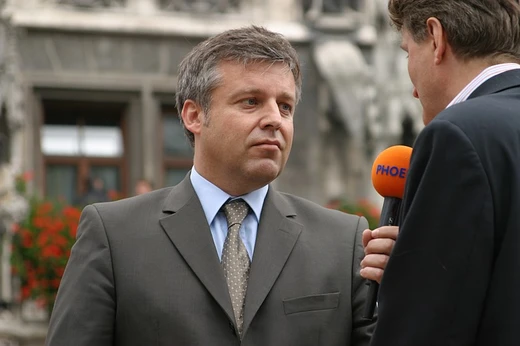
Paul Mason's path into journalism was neither direct nor conventional. After settling in London in 1988 and turning freelance around 1991, he spent the mid-to-late 1990s at Reed Business Information, contributing to titles such as Contract Journal, Community Care, and Computer Weekly, where he rose to deputy editor. His breakthrough arrived in August 2001 when he joined BBC Two's Newsnight as Business Editor. His very first live broadcast fell on the day of the September 11 attacks, a moment that would anchor the programme's coverage of that era. During his Newsnight years he also maintained a personal blog called Idle Scrawl and contributed to Radio 4's four-part Spinning Yarns series on the cotton industry in 2007. In 2008 he appeared in the first episode of Credit Crash Britain. In 2013 he moved to Channel 4 News as culture and digital editor, then became Economics Editor in mid-2014, succeeding Faisal Islam. He departed in early 2016, citing a desire to participate in public debate without the impartiality constraints that bind UK broadcasters. By 2024 he was contributing columns to The New European, Social Europe, Frankfurter Rundschau, and The Spectator.
Musical Roots and Northern Soul
Born in 1960 in Leigh, Lancashire, Mason grew up in a household shaped by two very different lineages: one grandparent toiled as a coal miner, while another was a Lithuanian-Jewish violinist. He attended Thornleigh Salesian College in Bolton before earning a combined degree in music and politics from the University of Sheffield in 1981. He then trained as a music teacher at the London University Institute of Education and went on to conduct postgraduate research into the Second Viennese School back at Sheffield, completing that work in 1984. For a period he worked as a practicing musician and lectured at Loughborough University. Music remained a lifelong thread. As a young man he was a devoted follower of Northern Soul, spending time at the legendary Wigan Casino. That passion resurfaced in September 2013 when he hosted a BBC Culture Show documentary exploring the Northern Soul scene, connecting his personal history to a broader cultural movement that had defined a generation of northern youth.
Political Voice and Creative Projects
Mason's political convictions have been a constant undercurrent in his work. A former member of the Workers' Power group, he later described his earlier activism as complicated, eventually identifying as a radical social democrat rather than a revolutionary Marxist. In 2015 he declared that capitalism was dying at a speech marking Naomi Klein's book launch, and he called for an unlikely alliance between Canary Wharf bond traders and placard-carrying Trotskyists against right-wing populism. His creative output reflects these commitments. In 2017 he wrote Divine Chaos of Starry Things, a two-act drama about Louise Michel and other Paris Commune exiles in New Caledonia, which The Guardian praised as intelligent and focused on the women of that story. That same year his play Why It's Kicking Off Everywhere was staged at the Young Vic and televised on BBC Two, dramatising his experiences during Occupy and the Arab Spring with Mason appearing onstage as himself. He also produced documentary series including #ThisIsACoup on the Greek crisis, K is for Karl for Marx's bicentenary, and R is for Rosa, commissioned by the Rosa Luxemburg Foundation. He is sole director of Exarcheia Ltd, a political consulting firm.
Recognition and Later Intellectual Life
Mason's body of work has earned him a steady stream of recognition across journalism and broadcasting. He received the Wincott Prize for Business Journalism in 2003, was named Workworld Broadcaster of the Year in 2004, and collected the Diageo African Business Reporting Award in 2007. In 2018 the Broadbent Institute, a Canadian think tank aligned with the New Democratic Party, presented him with the Ellen Meiksins Wood Prize. The Erich Fromm Prize followed in 2020. His intellectual engagement continued well beyond the newsroom. In May 2024 he was appointed Aneurin Bevan Associate Fellow in Defence and Resilience at the Council on Geostrategy, a think tank focused on strategic affairs. By 2025 he had become a regular voice on the Council's Defence Talks: Securing UK Advantage podcast, discussing geopolitics and defence policy. He has also authored several books, and in a 2018 New Statesman piece marking Marx's bicentenary he praised the tradition of Marxist humanism, underscoring how his journalism, creative writing, and political thought remain deeply intertwined.
More in Journalists & Broadcasters 1-19
Spotted an error? Know more?
This is a living reference — every entry is fact-audited, and reader corrections feed straight into our audit queue. Suggest an edit · See this site's audit record